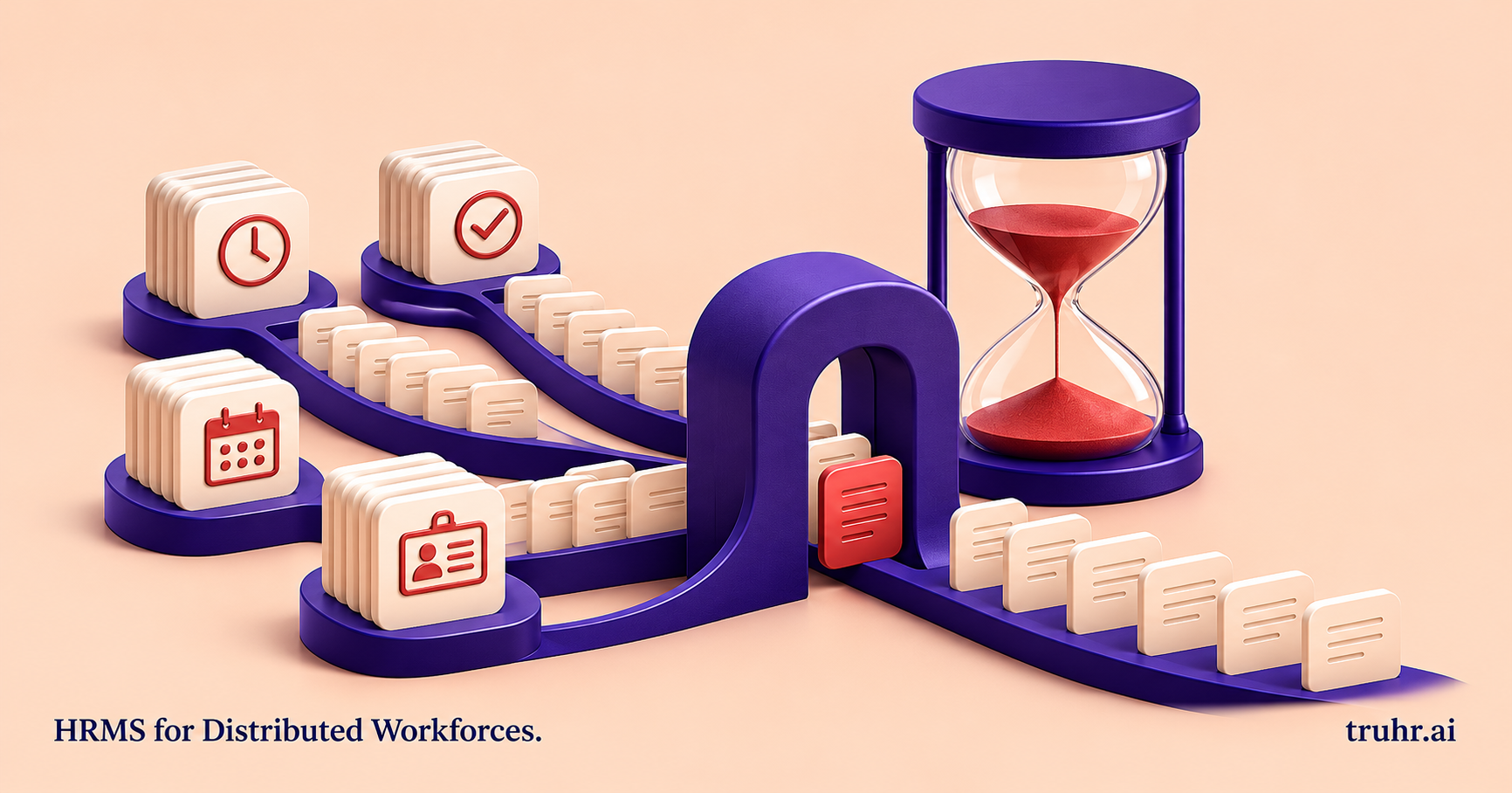
Payroll preparation can feel busy even when salary calculations are straightforward. HR waits for a branch to confirm attendance, reminds a manager about overtime, checks an employee update and revises the same sheet again.
The work is happening, but the process is not moving smoothly.
Before adding another reminder or report, ask a more useful question: where does payroll preparation spend the most time waiting? Identifying that bottleneck helps HR focus on the change that will make the next cycle easier.
Four places to investigate
Missing attendance
Incomplete punches and unconfirmed attendance create follow-up work. Across multiple locations, the delay may come from late submissions, device issues or unclear responsibility for corrections.
Look beyond the number of missing entries. Are they concentrated at one site? Does HR receive them on time but wait several days for clarification? These situations need different solutions.
Manager approvals
Leave, overtime and attendance corrections may be entered promptly but remain pending with a manager. Repeated reminders can hide the underlying issue: an unclear approval deadline, an absent approver or requests routed to the wrong person.
Check where requests stop moving. A longer list of reminders will not solve incorrect ownership..
Leave and overtime corrections
A request may be approved but still need rework because dates, hours or supporting details are incomplete. HR then returns it for clarification and waits for another version.
Identify what is repeatedly corrected. If managers interpret the same rule differently, the process needs clearer guidance before the next submission.
Employee data changes
Joining dates, exits, salary revisions, transfers and bank details can reach payroll at different times. A correct update can still cause rework if it arrives after the relevant inputs have been finalised.
Check whether each change has the necessary details, approval and effective date. Payroll teams need clarity about which period the change affects.
Separate work time from waiting time
A correction may take ten minutes to process but three days to obtain. Treating both as “payroll work” makes the real delay difficult to see.
For one payroll cycle, keep a simple record of unresolved items. Capture the issue, location, responsible person, date raised, date resolved and whether it required rework. Use your existing system where possible.
Review two things separately: how much hands-on effort HR spends and how long each item stays open. A frequent issue may consume the most effort, while a less common approval delay may hold up finalisation.
Find the cause behind the recurring issue
Suppose one branch regularly submits overtime details after the cut-off. The immediate explanation is “late submission”, but the cause may be more specific.
Perhaps the manager waits for a weekly report. Perhaps employees submit hours without dates. Perhaps nobody knows who approves the request when the usual approver is away.
Discuss the recurring pattern with the people involved. Agree on what a complete submission looks like, who acts next and when escalation is needed. This turns a broad complaint into a fix the team can apply.
Fix one bottleneck first
Trying to redesign every HR process before the next payroll run can create more work. Start with the issue that causes the most delay or repeated effort.
If approvals are the problem, clarify the approval owner, review deadline and authorised backup. If employee changes arrive incomplete, standardise the required details and effective-date confirmation.
If one location accounts for repeated attendance gaps, review its capture and correction process with the local team.
Keep a clear route for genuine late changes. They still need review and a decision about payroll treatment; they should not disappear because a deadline has passed.
Check whether the change helped
In the next cycle, compare the same measures: unresolved items at cut-off, time spent following up, average time to close an issue and corrections requested after finalisation.
Use the comparison to refine the process. Fewer open items are useful only if the underlying information is complete and accurate. Closing requests without resolving them simply moves the problem downstream.
Where a connected HRMS helps
TruHR brings employee records, attendance, leave, shifts and payroll together for distributed and shift-based teams. Connected information can reduce the need to reconcile separate records and help teams work from a more consistent view.
The process still needs clear responsibilities and timely decisions. Software supports those arrangements; it does not replace them.
Before your next payroll cycle, identify the one issue your team spends the most time chasing. Give it an owner, address the cause and measure the result.
Explore TruHR to connect everyday HR processes across locations and shifts.
HRMS for Distributed Workforces.