What Is Employee Self-Service? Benefits and Features HR Teams Should Know
Share
Key Takeaways
The term employee self-service (ESS) refers to technology that enables employees to take care of HR-related tasks without needing help from HR.
Common employee self service features include accessing pay statements, requesting time off, updating personal information, and managing benefits.
Employee self service benefits include faster access to information, reduced administrative work, improved data accuracy, and greater employee autonomy.
ESS works best when integrated with payroll, attendance, benefits, and broader HR systems.
Human resources teams spend a significant amount of time answering recurring questions and processing routine requests. Employees may need a copy of a pay statement, want to update their contact information, check their time-off balance, or submit a leave request. When every task has to pass through HR, even simple transactions can create unnecessary delays.
Employee self-service changes that workflow by giving employees-controlled access to the information and HR processes relevant to them. Modern ESS tools are commonly built into HRIS, HRM, or HCM platforms and can be accessed through web portals or mobile applications.
What Is Employee Self-Service?
So, what is employee self-service? Employee self-service, commonly called ESS, is an HR technology feature that allows employees to access and manage their own employment information and complete routine HR tasks.
The employee self-service meaning is simple: employees get controlled access to information and processes that previously required HR assistance.
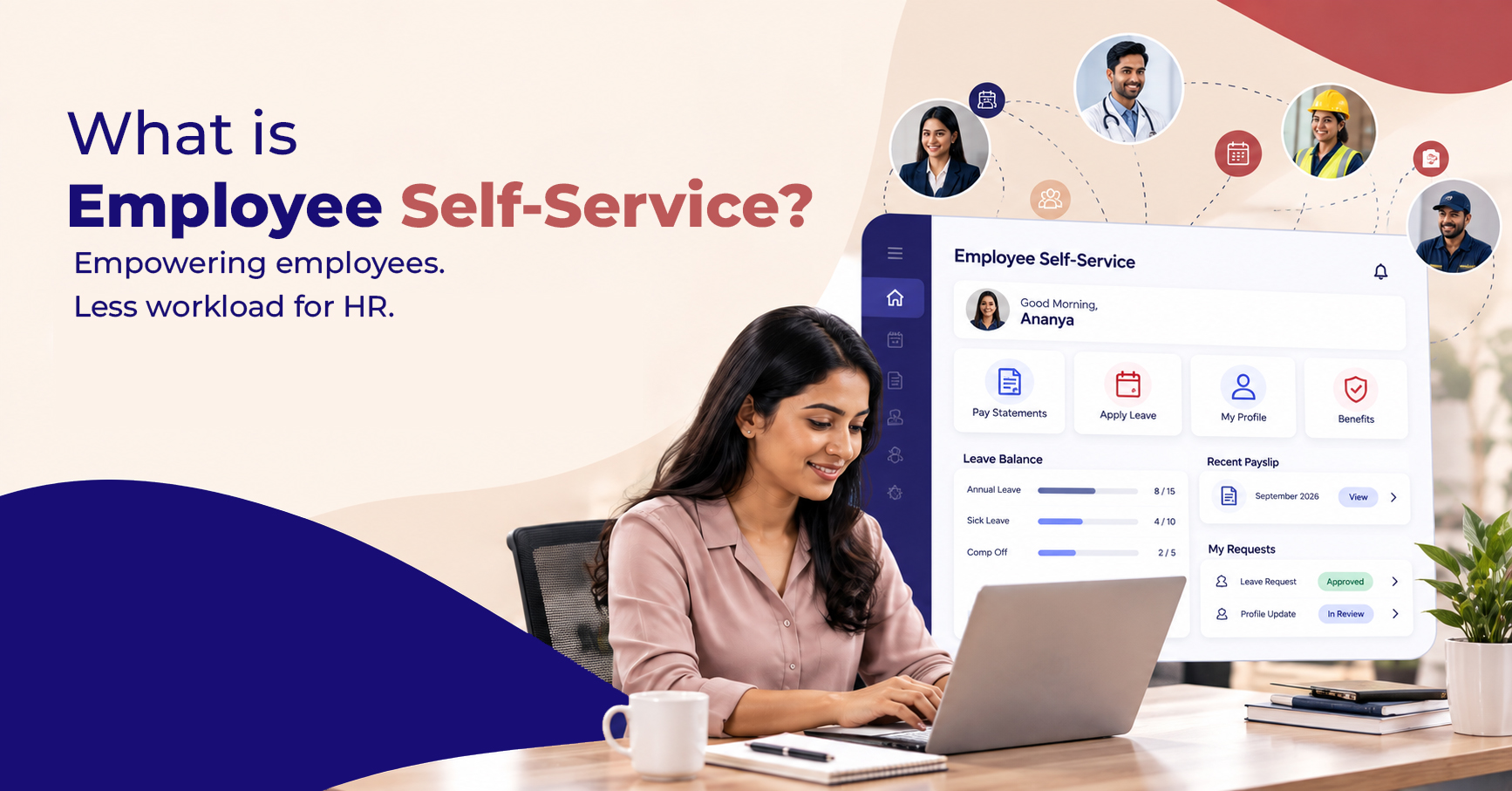
Depending on the platform, employees may be able to update contact information, view pay statements, request time off, check leave balances, access benefits information, and retrieve HR documents.
ESS does not remove HR oversight. Permissions, approval of workflows, and access controls allow HR teams to determine what employees can change independently and what requires review.
What Are the Main Employee Self Service Features?
As with most ESS systems, the exact features depend on the platform, but almost all of them include some of the typical HR functions.
Personal Information
Employees can review and update details such as addresses, phone numbers, emergency contacts, and other profile information.
Payroll and Pay Statements
Employees can access pay statements and, depending on the system, manage certain payroll-related information such as direct deposit details. This can connect with broader payroll management processes handled by HR teams.
Time Off and Attendance
Employees can log in to ESS platforms to see their leave balances, request time off, view attendance, and check the status of their leave requests.
Benefits Management
Employees can typically view available benefits, enroll during open enrollment, update dependent information, and make changes following a qualifying life event.
Documents and Policies
An employee portal can provide access to handbooks, company policies, tax documents, forms, and other employment records.
Mobile Access
Mobile ESS allows employees to complete routine tasks without being tied to an office computer, which can be particularly useful for remote and distributed teams.
What Are the Benefits of Employee Self Service?
The benefits of employee self-service extend to both employees and HR teams.
Faster Access to Information
Employees can find commonly requested information themselves instead of waiting for an HR response. This is useful for pay statements, leave balances, benefits, and company documents.
Less Administrative Work for HR
When employees handle routine transactions, HR teams spend less time answering repetitive questions and processing simple requests. That gives HR more time for employee relations, workforce planning, and other higher-value responsibilities.
Greater Employee Autonomy
Employees have more direct control over routine aspects of their employment, such as updating personal details or submitting leave requests.
Better Data Accuracy
Allowing employees to review and update their own information can help keep records current and reduce unnecessary manual data entry.
More Consistent Workflows
Digital workflows can standardize how requests are submitted, approved, and recorded, making it easier for HR teams and managers to track activity.
How Does Employee Self-Service Fit into HR Software?
ESS will not be a standalone solution but is likely to be integrated into larger HRIS, HCM, or HR management software. It may integrate employee-facing functions with payroll, attendance, benefits, records, and reporting.
For example, employee management software can centralize employee information while ESS gives workers appropriate access to their own records and HR processes.
Platforms such as TruHR combine employee-focused HR functions with tools for areas such as attendance, leave, payroll, and employee management.
What is employee self-service?
What are the main employee self-service benefits?
Common benefits include faster access to information, reduced HR administrative work, greater employee autonomy, improved data accuracy, and more consistent HR workflows.
What are common employee self-service features?
Does employee self-service replace HR?
What is the difference between ESS and HR management software?
TruHR transforms traditional HR management by automating essential tasks such as onboarding, attendance, leave management, payroll, compliance and field employee management.